CAPACITOR-BANK
DISCHARGE EXPERIMENTS
w/ Dale Travous' capacitor bank, Seattle.
6/15/94 William Beaty
This page is intended for an adult technical audience, and
has a RSACi rating of V4. If your kids
can see it, then you are not using an Internet Filter to block violent
content.
DISCLAIMER: the experiments described below really are fantastically
dangerous, and they are described without reference to the many precautions
needed to guarantee the experimenter's safety.  Accidentally discharging
these capacitor banks through your body can not only kill, but can explode
flesh and bone. The "exploding water" effect can launch electrode fragments
at high velocities.  The "watergun" is a full-fledged cannon, and must be
treated as such.  And these are not the only hazards.  I describe these
experiments for your information only.  Anyone who attempts to duplicate
them does so at their own risk.  And the risk is considerable unless you
know EXACTLY what you are doing.  If you don't have lots of experience
with lethal high voltage and the effects of explosives, stay safe and steer
clear of this stuff.

PARENTS: I supply no detailed plans for reproducing these experiments.
Also, these experiments require large and expensive lab equipment which
is not obtainable by children.  (And the plans for an atomic bomb are safe
for children too, because kids can't afford to buy kilograms of
Plutonium!)  If your kids have access to 5,000 volt high-current power
supplies, then they are already in great danger, whether or not they read
about my capacitor discharge experiments below.
My Other High-voltage Projects
- My history as an HV kid
- Safe HV source: negative ionizer
- HV Voltage-regulator for your VandeGraaff Generator
- One-atmosphere Plasma Globe and others
- Duluc's 'Dry Pile'
- Kelvin's Thunderstorm
- Soda-bottle Voltage Motor
- "Air Threads" electrostatic phenomenon
- Weird air-ion experiments
- Kitchen HV: microwave ovens
- HV Diodes & wire for Tesla Coils
- Tiny $5 Tesla Coil
LINKS: Other Cap-Discharge sites
- Dale Travous / Gary Hawkins "Z-pinch" metal crushing (pdf, Bert H.)
- vid: The Electromagnetic Hammer NASA Langley
- T. Johnson Can Crusher
- Hickman Quartershrinker
- History of quarter shrinking
- T. Stewart can crusher, railgun
- Sam Barros' Powerlabs
- EM pulse Can Crusher at RPI Plasma Dyn. Lab
- The Brasch Capacitron 1950s, enormous
- Sterilization by cap discharge?!
THE "WATERGUN"
by Bill Beaty, experiment by Chris P., Gary H., Dan Y. andDale Travous in ?1991? Water cannon built by Chris P.
The capacitor discharge gun was a 6" cylinder of mild steel, 2" diameter with a 1/2" hole bored most of the way through axially. At the base, two holes were bored in from the sides and threaded to take standard sparkplugs. The gun was fired at potentials ranging up to 40,000 Volts supplied Gary H's bank of six 3uF, 150,000-volt capacitors (about 1/2 cubic yard in size!) using 1-1/2" x 1/2" copper busbar as conductors. The switching gap was an aluminum slab with a moving small sphere and short length of metal rod inserted using air pressure. The charging supply was Gary's DC HV unit from an old X-ray machine. Later versions used a 50,000V neon sign transformer and strings of the high voltage diodes sold as replacement parts for microwave oven repair. About one cm^3 of water was placed in the gun, and a steel ballbearing was initially used as the projectile.
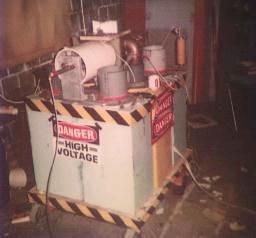
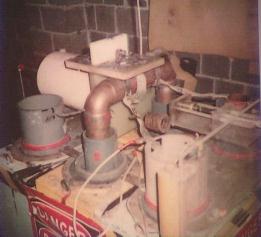
ABOVE: GARY H. CAPACITOR BANK
(gun not present, set up for 'shrinking' coins
In the initial tries, the sparkplugs blew out violently from the
gun, and the ballbearing was gently lofted from the barrel. We assume
that the force originates in the discharge gap, and so we need to
position the gap closer to the base of the barrel.
The sparkplugs were replaced with turned teflon rods and copper wire
conductors, with the single discharge gap centered in the barrel. The
ball bearing was replaced with one found by Gary H. (syncronicity!) a
black polyethelene cylinder with flat
ends, which gave a perfect slip-fit into the bore. A clay cube of about
10" to
12" thick (water based modeling clay) was used as a target. When fired, the
teflon rods and the copper conductors were still blown out of the holes.
But this time the slug went through the entire clay block, leaving a large
entrance hole and a tiny exit hole. The entrance hole was conical, with
ripples and a spiral on the walls, the spiral extending the entire cavity.
Amazingly, the projectle had not the
slightest bit of damage, and the edges of the beveled end were even still
sharp and polished, and the small paper lable still there. Even more
amazing, after going through the entire
block of clay, the slug was stopped by the thin poly bag that covered the
back of the clay block.
5/95 - In the spring issue of ELECTRIC SPACECRAFT JOURNAL, the Richmond
Virginia Tesla Coil Builders Assn. have an article on their own watergun
experiments. They manage to perforate a 1/4" aluminum plate with
nothing but the water fired from the end of the gun. Yet a few feet
downstream, one can place a hand in the jet (only stings.) They attempt
to look for anomalous energy production, but their results are
inconclusive.
For info on subscribing to ESJ, see FREE ENERGY NEWSLETTERS AND JOURNALS
in WWW Weird Science at http://amasci.com/weird.html
Some references recommended by Tom Coradeschi
IEEE Transactions on Magnetics:
Vol. MAG-18, No. 1, January 1982
1980 Conference on Electromagnetic Guns and Launchers
Vol. MAG-20, No. 2, March 1984
2nd Symposium on Electromagnetic Launch Technology
Vol. MAG-22, No. 6, November 1986
3rd Symposium on Electromagnetic Launch Technology
Vol. 25, No. 1, January 1989
4th Symposium on Electromagnetic Launch Technology
Vol. 27, No. 1, January 1991
5th Symposium on Electromagnetic Launch Technology
Vol. 29, No. 1, January 1993
6th Symposium on Electromagnetic Launch Technology
Vol. 31, No. 1, January 1995
7th Symposium on Electromagnetic Launch Technology
SOME CAPACITOR EXPERIMENT RESULTS,
7/10/94
or, Blowing Stuff Up: a "guy thing"
Gary H. and I tried discharging his capacitor bank through small pieces of
agar gel with various electrode lengths and spacing. Capacitors: three
100uF, 30,000-volt units in parallel. Switching gap: two 1-1/2" brass
spheres moved by an AC solenoid, with flexible contact made via several
flat 1" ground braids. 8" lengths of heavy solid copper wire (#12?) were
run from the capacitor terminals and were bent to form a gap, into which
small blocks of agar were placed. A styrene cottage cheese bowl was
placed below the gap to shield the capacitor conductors from agar
splatter. A 12" Tupperware bowl was placed over the gap to shield the
rest of the room from flying agar.
At lower voltages (under 2,000V) there was no explosion. Instead, the
agar glowed yellow, sputtered, and melted adjacent to one electrode wire.
This is similar to the "glowing 120V pickel" demo, where an arc burns
pickel flesh from around an electrode with a crawling arc which
sequentially attacks the material closest to the electrode.
With electrodes inserted 1/2" into the agar at 1" spacing and 2,500V,
there was an extremely loud blast which shattered the styrene cottage
cheese bowl we had placed below the wires in an attempt to shield the
conductors from agar splatter. But even with a blast like a shotgun
discharge, the agar simply broke into several pieces and fell from the
electrodes. The explosion was all sound, but with very little mechanical
force.
With 1/2" electrodes at 1/4" spacing, the blast was extremely loud, the
agar was thrown out from the discharge as a liquid spray, the cottage
cheese bowl was again shattered and blown downwards, and the 10"
tupperware bowl that covered the assembly was shattered! Bill thinks it
happened not only from overpressure, but from fast risetime of force which
shattered the plastic like sillyputty with a hammer. Because the agar was
liquified rather than gently fractured as before, we suspect that the
voltage and spacing in the previous run must have been just at the
explosion-producing threshold. Also note that the explosion energy seems
to be nonlinear with respect to e-field, and with respect to total input
energy, since reducing the gap while keeping capacitor voltage and
capacitance constant seems to have enormously raised the energy output.
Perhaps energy is proportional to peak current? Or perhaps there is a
threshold in the voltage or current below which explosion energy falls
rapidly.
Since the discharge is intensely loud, Bill suspects that the extremely
loud noise from the quartershrinker[1] setup may be coming from the
switching gap, and not from the exploding coil. After all, covering the
quarter with the iron pipe did not reduce the noise all that much. Dr.
P. Graneau has written about anomolies with high current air arcs,
pointing out in particular that the sound from lightning may not simply
be from thermal transient air expansion, but from unexplored plasma
dynamics which produce shock waves via motor effects. Perhaps this is
the source of the intense sound from the discharge.
 [1] Quartershrinker: device which electrically compresses a coin
   into a small, shrivled, spherical lump.  See pdf, EXTRAORDINARY
   SCIENCE, Vol 5 No.3, Summer 1993, p10 (pub of the Intl. Tesla
   Society, Colorado Springs, CO.  Email the author at ghawk@eskimo.com,
   or contacts, http://nrgcycle.com/
IDEAS FOR THE FUTURE:
Place a glob of jello against a solid sheet (metal, plastic, etc.)
Stick capacitor wires in the jello. Fire the capacitor bank. Will
the exploding jello shatter or dent the plate? Place it against
a coin. Will it cause dents? Can exploding jello drive a quarter
into a block of wood?
Obtain a satellite TV dish. Suspend a jello-glob blaster (as above)
a little farther away than the dish focus. Find the distant
secondary focus optically, and place objects there. Fire off
the capacitor bank, and see if the refocussed blast wave can do damage
at a distance. Blow out a candle at fifty paces? Shred a roll
of toilet paper? Atmospheric lithotripter!
Measure the output energy of the capacitor bank's discharge.
"Free energy" test: fast, high current impulses tend to do weird
things. Are they a F/E source? Discharge the capacitor many
times in a container of water. Measure the temperature increase,
and calculate energy input. Calculate electrical energy use.
Is it anywhere near unity? Is it over unity? Fire a supergun
upwards with a heavy bullet, measure the height. Fire it into
a ballistic pendulum, measure the height.
Coil-crush a quarter inside a heavy pipe full of oil. Is coil still
destroyed? (Put it in a big baggie to limit the mess)
Blow a bare coil inside a cup of water. Anything interesting happen?
Is explosion symmetrical, or do water jets form? Is there a difference
between fresh water and electrolyte?
Drill a 1/2" depression in a metal block. Fill it with water.
suspend a wire that touches the center of the water. Discharge
the capacitor between block and wire. Is safety shield needed?
Maybe not, and the plasma jet will be easily observed. Try
different sizes of holes. Try a deep hole with a drop of water in the
bottom and a long conductor making contact. Direct the jet against
various materials.
Run the capacitor leads to a baggie of water. Fire it off, and
make a mess. Do it with paint in a parking lot, maybe several
colors and various objects to make blast shadows. A big blast
with manniquins against a wall makes "Hiroshima" effects.
Fill a flexible (rubber?) container with water, insert capacitor
leads. Try firing it with low voltages, see how high a voltage
is needed for explosions. Try firing it with various electrode
separations. What exactly is needed to make water explode?
Install a heavy polycarbonate window on the above rubber bucket, and
observe small water explosions underwater.
Discharge a capacitor bank through the ground, while using geophones
to listen at great distance. How far can the sound be detected?
Instead, use electrodes and an audio amp to listen at a distance.
How far away can the EMF effects be detected?
Can "machinable ceramic" stand up to water blasts? If so, make a
reusable cannon: Bore a large hole most of the way through a 2"
metal bar. Bore a much smaller hole the rest of the way. Carve
a thick disk of ceramic that slip-fits into the large bored hole.
Drill a hole through the center of the ceramic disk. Machine another
electrode in the shape of a giant nailhead. Stick this through
the ceramic disk, so the shaft of the "nail" extends out the back
of the cannon, and the ceramic separates the center electrode from
the metal cannon. Put a little water in the cannon, and discharge
the capacitor between the cannon and the center electrode. If the
ceramic can take the shock, the device is reusable. If a small-
bore cannon with lots of water is used, the slug of water itself will
become the projectile. P. Graneau claims that such a waterslug can
penetrate a 1/4" aluminum plate. But how big a capacitor bank did
HE use?
              ___          ___
             |   |        |   |
             |   |        |   |
             |   |        |   |
             |   |        |   |
             |   |        |   |
 ASSEMBLED   |   |        |   |
  CANNON     |   |        |   |
             |   |        |   |
             |   |        |   |                         CENTER
             |   |        |   |                        ELECTRODE
             |   | ====== |   |           CERAMIC       ======
             |   | ==||== |   |          ___   ___        ||
             |   |+++||+++|   |         |+++| |+++|       ||
             |   |+++||+++|   |         |+++| |+++|       ||
             |   |+++||+++|   |         |+++| |+++|       ||
             |    \++||++/    |         |_++| |++_|       ||
              \____|+||+|____/            \_| |_/         ||
                     ||                                   ||
                     ||                                   ||
                     ||                                   ||
                     ||                                   ||
MORE STUFF:
F/E testing: discharge in a calorimeter repeatedly, maybe use sorbothane
packing around sphere electrodes, see if T(rise) is anomolous. Underwater
discharges are probably too destructive to containers
Discharge underwater with plastic or wax lenses to refocus the shockwave and
destroy objects at the lens focus.
Place a small water drop on a metal block, touch the drop with a metal
wire, connect the block and wire to the discharge capacitor. Is the
block surface damaged?
Try inducing long discharge paths using wet thread, the thinner the better.
Will curved thread cause shockwave focusing effects?
Wrap wet string around a thin plastic tube, place a quarter inside.
Perhaps the discharge will form a spiral arc with good conductivity
which will warp the coin without requiring the destruction of a copper
coil?
Try graphing sound peak amplitude versus capacitor voltage for a constant
length short arc. Force an arc initiation at all voltages by using wet
filaments or #40 wire across electrodes. Is sound proportional to voltage,
energy, or what? If more than proportional to energy, F/E is revealed?
Are water-arcs different from other arcs? Run some very thin wire to a tiny block of jello and fire it off. Does the exploding jello give a different explosion pattern than the exploding wire?

