Created and maintained by Bill Beaty. Mail me at:
 .
.
|
|
A Brief HistoryPlasma Globes were invented by Nikola Tesla some time before 1892.
Glass-enclosed Tesla coil terminals containing low-pressure gases were
part of Tesla's effort to develop a new source of lighting not covered by
the
Edison patents. In 1974 The same device became an art object when William
Parker,
an intern at the Exploratorium museum in SF, redesigned the older "Argon
Candle" science exhibit to produce a long plasma streamer. Parker named
the device
"AM Lightning". His later devices were spherical and contained
various gas mixtures producing a wide variety of nonlinear plasma
phenomena. Parker exhibited these in Cambridge MA at the
MIT Compton Gallery in 1985, and sold large versions to science
museums world wide.
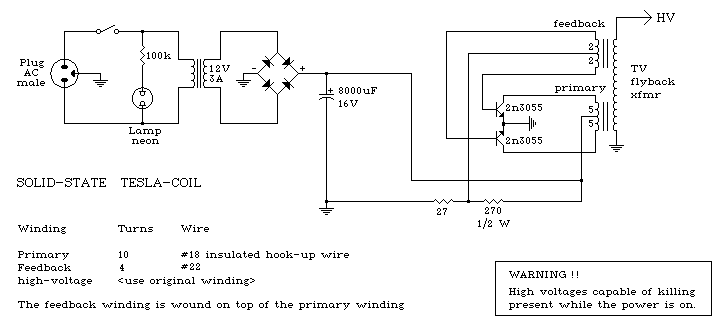
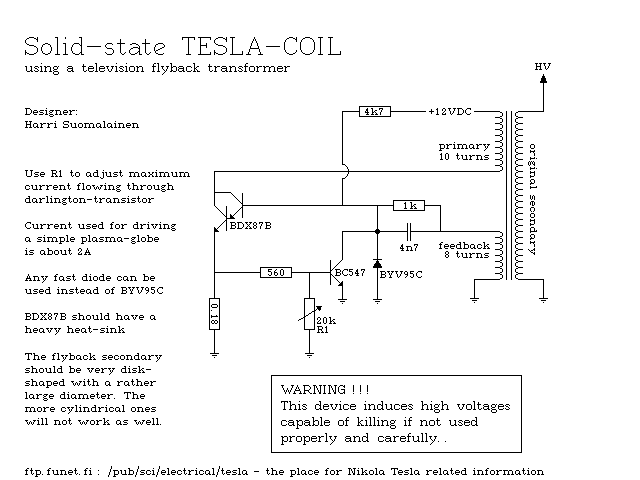
Bill B's short Plasma Sphere instructions for experienced electronics hobbyists:First built a tiny Tesla Coil based on a flyback trans former. Flyback units can be had from old TV sets or dead computer monitors. Build your Tesla Coil using one of the following schematics:
If you want to get ambitious you can eliminate the light bulb.
Instead build your own glass globe. Use a glass jar, or better yet a
boiling flask from a mailorder chemistry
supplier or a lab
glass outfit. Stopper with a 3-hole stopper. Provide two hoses, one
to inject gas, the other as an outlet. Push the inlet hose deep into the
flask so the injected gas can push the air ahead of it. Tape a layer of
paper towel around the end of the gas tube inside the bulb. (Or perhaps
stuff some fiberglas in the tube end.) This acts as a gas diffuser to
prevent turbulent mixing. Insert a wire into one hole as the H.V.
terminal, with the tip of the wire centered in the flask. Turn on the
tesla coil, turn out the lights, then use pure Argon to slowly flush the
nitrogen out of the glass globe (welding argon is pure enough. Note that
argon is slightly heavier than air.) As the N2 and O2 is replaced by the
Argon, the small corona discharge on the wire in the globe will grow
larger and larger. When the discharge is large and white, turn off the
argon and clamp the hoses. Seal the stopper holes with epoxy if desired
(don't use silicone caulk, the acetic acid fumes destroy the plasma
effect.) X-rays/Ionizing radiation from light bulbs A note about x-rays. When placed atop a Tesla coil, some small bulbs fail to produce
purple streamers of plasma. Instead the space inside the bulb remains
dark. But the glass flickers blue, or white, or sometimes green. This
shows that the bulb contains a fairly hard vacuum. And at high voltage
(above 10KV,) such a bulb will produce soft x-rays as electrons
slam into the glass and cause x-ray fluorescence via "Bremsstralung".
USUALLY the x-ray intensity is insignificant. They're far too little to
light up a fluorescent screen. (No viewing your own bones! Aww too bad.)
They might pass through aluminum foil and cardboard, but they won't pass
through steel. But they will make a geiger counter fairly ROAR with
clicking, but only if the GM probe has a thin window (for alpha particles
and x-rays below 50KeV.). The response of the alpha-window geiger counter
on an x-ray light bulb is about the same as that for a hunk of uranium
mineral. X-ray sources: All radio tubes, crt tubes, many types of small
appliance bulbs, oblong aquarium lights, lectern bulbs, museum-case bulbs,
exit sign lamps, screw-in xmas bulbs, etc., any small cheap incandescent
bulbs which lack an argon fill. These will produce weak low-energy
ionizing radiation when used as a "plasma globe." I've heard that the
x-ray output is a bit higher if the filament is incandescing via a
floating battery. And it's much higher if a piece of grounded metal foil
is glued to the end of the bulb. So, to avoid even the slightest x-ray
hazard, use only the large 4-inch spherical bulbs for your "plasma globe."
Or at the very least, only use bulbs which produce a bright blue/violet
gas glow at the filament. If in doubt, use a Geiger Counter to detect any
x-rays. Stay away from those small green-fluorescing aquarium bulbs!
Here's some radiation info, compare x-ray hazards to the risk of
canoe trips and eating peanut butter . Construction Articles in Magazines
Back issues of RADIO ELECTRONICS magazine, HANDS-ON ELECTRONICS magazine, and EXPERIMENTER'S HANDBOOK magazine are available from your local public library via the Interlibrary Loan service. Contact the reference desk. Also see Plasma Sphere without vacuum pump for more info. OLD LINKS GONE BAD? Try http://archive.org, "The Wayback Machine" It offers billions of old websites and even some of the graphics. But it's not searchable. You have to know the URL of the old site. Quick link to old sites: simply add this prefix to any expired URL: http://web.archive.org/web/*/ |
.