THE BAD DIAGRAM
The laser's in-phase emission arises in other topics: it's the basis
for transparency of materials. For example, whenever atoms in a glass
window absorb light waves, they re-emit those waves in phase, so the
original wave is preserved and the material acts transparent. In-phase
emission prevents the light from scattering when it interacts with the
atoms in the glass. So yes, the atoms in the laser-rod or laser gas-tube
emit light in phase... making the laser material transparent, and this
preserves whatever coherence that the incoming light might already have
had. The "in phase" textbook laser diagram below is actually, heh,
explaining transparency. Incoherent light could also get amplified
and bounce as shown below. So, the authors never bothered to tell us how
the light became coherent in the first place.
 |
If fig. 1 above is wrong, then what's right? See fig. 2 below. If we
could actually see
individual light waves, what would coherent light look like? Fortunately
the explanation is quite simple. Take a look at figure 2A below. That's
what perfectly coherent light would look like if we could see the waves.
Coherent light is simple: it's light which comes from a very small light
source. Light from a single source is always coherent, since incoherence
requires two sources. Spatially coherent light has another name: "sphere
waves"
or "plane waves." Or even simpler: "pinhole light" or "pointsource light."
![[tiny dot sends out a bullseye shape of red waves]](/graphics/sphere2a.gif)
|
![[tiny dot sends out a sunburst of red rays]](/graphics/sphere2b.gif)
| |
| A. | B. |
A perfectly coherent source is simply a point-source.
A single small light source sends out electromagnetic waves in all directions
as shown above. Of course these diagrams are only two-dimensional, while the
real situation is 3D. We can visualize a coherent wavefront to be spherical.
The waves are like layers of a spherical onion, but where the onion is
expanding at the speed of light, with new layers constantly added in the
center. OR... we could imagine that the tiny light source is sending out a
stream of particles flying off in all directions. The paths of these
particles are the "rays" of light. Since they all fly outwards from a single
point, none of the rays cross each other. And if this light is passed
through a converging lens, it's focused to a perfect point.
Coherent light is just some:
- Rays which never cross each other; parallel or radial
- Perfect wavetrains in 3D; nested sphere-waves or plane-waves
So coherent light is just "pointsource light?" Paraphrasing Feynman: Now
I Understand Evvvvvrrreeethiiing! Finally it all makes perfect sense:
starlight is ULTIMATELY coherent, that's why Stellar Interferometry works.
Starlight has coherence-lengths in thousands of KM, starlight is far more
coherent than any human-made laser light. And the most distant stars are
just like ideal point sources. I remember AA Michelson discovering that
Betlegeuse is far less coherent than other stars. Ha, far less like a
microscopic pointsource! Then
I suddenly remember Dennis Gabor,
inventing holography before lasers existed. To create his pseudo-lasers
he just took light from an ordinary mercury-arc lamp and passed it through
a pinhole. Mercury's emission line made it nearly monochromatic, and the
pinhole gave it the spatial coherence.
Pinhole pinhole, ever hear of an
optics device called a
"Spatial Filter?"
They're used to 'clean up' laser light and make it
much more spatially coherent. A Spatial Filter is just a very small
pinhole with a converging lens upstream: any "incoherent" parts of the
beam will
never make it through the tiny aperture. It restores an imperfect laser's
point-sourcey-ness.
And finally I know why lasers are so wonderful: lasers are pinhole light
sources which are ...actually bright! It's always been easy to make some
coherent light, just use a normal light source and an optically small
pinhole (a halfwave diameter.) A frosted light bulb can become a coherent
light source. But a pinhole aperture this small will block
nearly all the light from any conventional source. To experiment with
this, get a slide projector and make a slide with a pinhole: an Al foil
layer perforated by a needle. Add a narrowband green filter, and that's
your Gabor-approved 1940s laser source. Make some holograms? Heh, a bit
long exposure-time though.
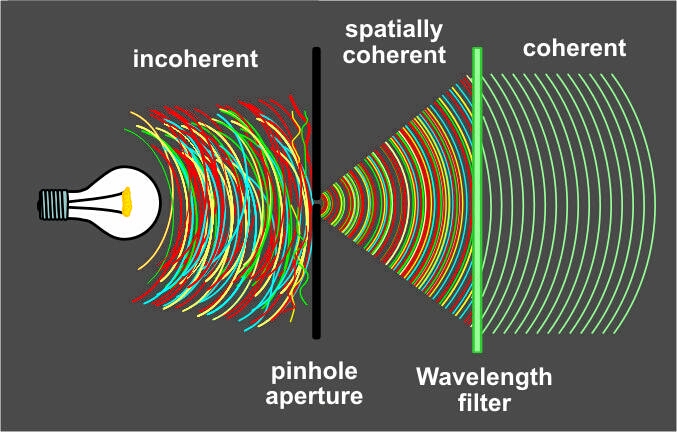 unattributed diagram found in online archives. |
In the distant past, monochromatic coherent sources were also
microwatt light sources, no getting around it. Creating coherent light
meant throwing away almost all of the power. Sending many milliwatts of
light through a wavelength-diameter pinhole was basically impossible.
So, all the bizarre and wonderful capabilities of lasers were unreachable.
But lasers easily solved the problem because, right at the start, they create
some
spherewave "pinhole light," as if their entire light output came from a
single virtual pinhole; a pinhole which is less than 500nM across. Aha,
those
confocal/concentric resonator mirrors, the ones used in lasers? This
means that the "virtual pinhole" in an actual laser is just a non-virtual,
very real pinhole-image sitting in the space between the mirrors. (See
wikipedia diagrams for optical cavities,
http://en.wikipedia.org/wiki/Optical_cavity). And all of those
Semiconductor Lasers with parallel mirrors: they just employ an "infinite
mirror tunnel" in order to place their pointsource at virtual-infinity
distance,
where it behaves just like the light from a distant star. During its trip
down the infinite tunnel, all the non-planewave light wanders out the
sides of the tunnel. Only planewave light can persist in the tunnel and
get amplified.
So ...laser coherence is created by the mirror-tunnel. Not by
transparency or stimulated emission or 'stacked sinewaves." Or in proper
terms, coherence is created by the laser's Fabry-Perot resonator cavity,
and not by any sideways packing of long narrow string-like "photons."
And all the above means that we now have a simple, gut-level intuitive
picture of laser coherence. What is it? Coherent laser light is just
pinhole-light
produced by
an infinite mirror-tunnel, with amplification. Sort of like those disco-era
mirror-infinity toys from Spencer Gifts. But the depths
of their virtual tunnel wouldn't be dark. On each reflection, the light
passes through the laser-medium and gets slightly brighter. And on each
pass, the "virtual source" seems farther away inside the tunnel. Viewed from
the end, each deeper segment of the "tunnel" appears slightly brighter and
smaller ...and the far end of the tunnel looks like an infinitely bright,
infinitely tiny star. If you stare into the depths of the Amplifying Disco
Infinity Mirror, the "star" is small and bright enough to punch a hole right
through your retina. And it doesn't even have to be very bright to do this!
A hundred-watt incandescent light bulb doesn't slice up your retina, but a
quarter-watt laser can burn a tattoo permanently into the back of your eye.
"Coherent" can also mean "sharp when focused," since focused Coherent light
must all converge to an infinitely small point. (Yeah yeah diffraction
limit. We're talking simple idealized geometrical optics here.)
OK, if spatially coherent light looks like an expanding bullseye, then what
does INCOHERENT light look like? In the above diagram 2A, incoherence
instead would look like multiple pinholes and bunches of overlapped
bullseyes. Lots of interference patterns, and probably with the nodes
dynamically swerving around. Either that or it would look like fig. 2b but
with bunches of light rays from multiple pinholes, and the rays all cross
each other throughout the light beam. In both cases if the incorherent
light was focused by a lens, we wouldn't produce any infinitely tiny hot
spot. Can't punch holes in razor blades.
With our gut-level intuitive understanding of Laser Coherence, we can now construct a basic list of coherent light sources
Sources in increasing coherence
- Bright cloudy sky (least spatially coherent)
- Fluorescent tube lamp
- Frosted incandescent bulb
- Sun during clear weather
- Clear incandescent bulb
- Clear incandescent bulb w/noncoil filament (aquarium bulb)
- LED
- Electric welding arc 50ft away
- Laser (coherence-leng in MMs, up to a few Meters)
- Starlight (coherence leng 1000s KM)
As a little kid, did you believe that the light from clear incandescent
bulbs was more magical than the frosted ones? And the light of garage
welders was even more magical still? If so, you were intuitively
experiencing optical coherence. Your little brain was wanting to mess
around with laser sources, rather than overcast daylight.
A perfect ideal pointsource gives perfectly coherent light, while a wide
diffuse source gives the least coherent light. Turn the idea backwards: if
we
start out with perfectly coherent laser light, but then we send it through
a frosted screen, the light remains just as monochromatic, but it becomes
incoherent. Hey, I noticed that we can actually buy an incoherent-izer,
an
opto device for our optical bench. They're just a rotating frosted screen
with a little motor (since an unmoving frosted screen still leaves a small
bit of micro-scale coherence or "laser speckle.")
NO JPEG YET
REAL SOLAR DEATH-RAY
And now I have the answer to a big question that plagued me in childhood. No doubt all the nasty little science-boys like me had come up with this one. Why can't I make a death ray light-source? I could just get my big plastic fresnel lens and focus sunlight, and then somehow collimate it into a half-mm beam. The 0.50mm burning spot would appear anywhere along the parallel beam miles long. Write CHAIRFACE on the freakin' moon! But if we think about this now, it turns out to be impossible. Adding extra lenses to our solar furnace just creates a projector, where our parallel solar deathray spreads out and becomes a wide image of the sun. The darned sun isn't a pointsource. No thin beam is possible unless we include a tenth-micron pinhole in the optical path, and that turns the power into microwatts. The solution to the problem is simple: JUST REPLACE THE SUN WITH A 10KM WHITE DWARF STAR HA HAAAA! Keep the sun's brightness the same, but shrink the sun until it appears in the sky like a tiny star, like an extremely intense pinpoint. Now just use any big lens to gather a square meter of sunlight, focus it down to 1mm, then collimate it with a 1mm water-cooled short-focus quartz lens stolen from an ultraviolet microscope. Yes, the whole device is still a projector, but if we project the image of a pointsource into the distance, the result is an intense collimated beam. Other than a bit of diffraction it should work great: a few hundred watts in a parallel CW beam 1mm wide. Slice-a offs you fingas! Winston Kock, one of the early laser people at Bell Labs, said that laser
light is "sharper light" which can be used as a cutting tool. Exactly,
exactly! Winston Kock actually gets it. But the actual central concept is
that coherence or "pinhole light" is the whole reason for the "sharp light"
which does the laser-cutting. Lasers aren't particularly bright. Hundred
watt light bulbs? 5,000 watt spotlights for school play?? Or daytime
sunlight? If our sun was 10KM wide, or reduced to 10^5 times smaller in
visual angle, then its light would be spatially coherent like lasers, or like
an electric welding arc, and glancing upwards during the day might slice
grooves across our retinas. The lens of your eye will focus the white-dwarf
sunlight to a pinpoint rather than to a dim and safe little 0.3deg solar disk
on your retina. Only because sunlight
is non-parallel, because our sun is an extended source, our 1.5 KWatt/m^2
sunlight doesn't act like dangerous laser light. Hmmm, hold on a sec. If
sunlight is about 1500 watts per square meter, and your eye's pupil is about
1mm, then your pupil intercepts 1500W/.001^2 = 1.5mW. DOH! WRONG! OK,
staring at white-dwarf sunlight would actually be just like staring into a
cheap laser pointer. Those things don't become really dangerous to human
eyes until up around 5mW. AHA, but using binoculars would be bad, very bad:
5000X smaller exit aperture, creating an eight watt parallel beam 1mm in
diameter. Binoculars become like icepicks aimed at your eyeballs. Coherent
light can be nasty.
