Brainstorm!
"Congo blue" filters pass infrared light!
If you lay three layers of
Congo Blue on one layer of Primary Red, you form an opaque black filter
which is very transparent to IR!!!!!
Oh, so you're not impressed? Well, read on.
Back in 1994 when I was working for Eaton photocontrols, we had
all these big sheets of
opaque black Lexan plastic which was IR-transparent. It was intended for
curved,
vacuformed covers for the infrared sensors in truck's backup-alarms.
Viewing this plastic through an infrared-converter scope was very strange,
since the IR-scope changed the opaque black sheets into glass-clear Lexan.
And if I put the black sheets in a window, human eyes saw opaque black
plastic, while IR scopes (and monochrome security cameras) would see right
through it, as if it was glass. The IR scopes thought the black window was
totally transparent. Other tricks were possible. I could hide lettering
and artwork behind those opaque black squares against a wall, and the IR
video cameras would see the hidden art or message.
At one point I started wondering just how much IR light a human eye
could see. After all, if the infrared light was EXTREMELY BRIGHT (such as
the IR of a sunny day,) human eyes might still detect it. And remember,
if 30KHz ultrasonic sound is loud enough, you will hear it. Same basic
idea. I took a small piece of our black IR filter-plastic and cut it into
2in. oblong disks to fit over the eye-depressions in my own skull. I
taped them onto my face with black electrical tape. Yes, I looked odd,
but it worked! After I became accustomed to the darkness inside the
filters, I could see through them. Going outside on a sunny day was
stunning. The sky was almost black, while the trees and shrubs where all
frosty pink. The grass looked like fluorescent red cherry Koolaid powder.
Different colors of human skin were always the same light grey. People's
eyes looked very black, and certain dark clothing looked white. I was
afraid that I might damage my eyes, since the IR sunlight was very bright,
and my pupils were wide open. (After years of playing with these, I still
haven't hurt my eyes, so they're PROBABLY somewhat safe to use.)
I couldn't see anything indoors though, and I could barely see anything
during a cloudy day. This "IR vision" requires a sunny day in
order to work. YOU CAN'T USE THESE FILTER-GOGGLES FOR NIGHT VISION!
BRIGHT SUNLIGHT IS REQUIRED. If you want to actually convert IR to
visible, or to amplify light, go
buy a cheap night-vision scope from Harbor Freight Tools instead. Or try putting an IR filter over the
lens of a $20 Casio monochrome wrist camera
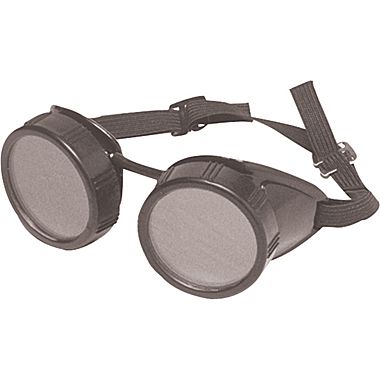
Later I found some $7 welders' goggles and cut some of the black "IR
plastic" into 2in. disks to fit the lenses. This worked great. I could
stagger
around in the noonday sun while observing the strange twilight-dark world
of the near infrared spectrum. Frosty white trees against a black sky.
Driving with the goggles was dangerous: I could see just fine, and cars'
tailights looked abnormally bright, but red traffic lights were totally
dark (here in Seattle they use red LEDs for stoplights which lack
the IR output of the original incandescent bulb.) Some sorts of car tail
lights, the LED kind, were also dark.
Goggles for All
Years later I used up my last small piece of black IR plastic. I still
had several pairs of the goggles, but it was sad that I couldn't show
others how to make their own. Perhaps some #89 Kodak Wratten
filters would work, but that stuff is wicked expensive, and I
never tried it.
But then one day I was messing with a Rosco filter booklet and happened
to hold a red filter over the IR filter-goggles and look outdoors. The
view was different. The red Rosco filter seemed to remove a
greyish-violet color
that I hadn't really noticed before. The IR goggles pass lot sof
infrared, but
for some reason they also seemed to pass some deep blue. Why would IR
filters let some blue light through? Heyyyyy... Which Rosco filter does
the same thing? Which type of filter passes a spike-spectrum of deep
blue, but it also lets through lots of IR? CONGO BLUE! Maybe our
plastic
supplier cheated. Maybe when Eaton ordered some visible-opaque,
IR-transparent plastic, they actually gave us Congo Blue plastic
with lots of extra dye added to the mix (so barely any visible blue light
would get through.)
Sure enough, when I stacked several sheets of Congo Blue filters and stuck
them in
my welding goggles, they acted much the same as those Lexan IR-pass
filters. I could go out
in bright sunshine and see the familiar pink-tree, dark-sky world. A few
small pieces of Congo Blue filter costs about $0.50... which means that ANYONE
can make these goggles now. No expensive Wratten filters or exotic
custom-ordered IR Lexan is needed.
Make Your Own
Needed:
- Bright sunshine or many hundreds of watts of 725nM IR floodlights
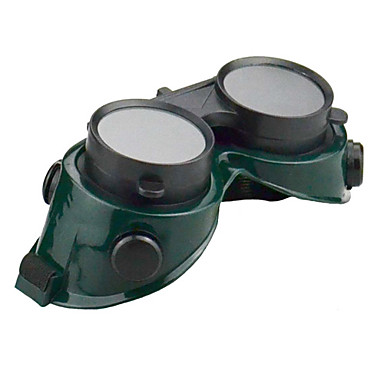
- Cheap welding goggles (w/removable filters)
(looks like these,
or maybe these )
- Sheet of "Congo Blue" filter gel (Lee #181, or Rosco #382)
costs maybe $8 for 24" sheet
- Optional: sheet of "Primary Red" filter gel (Lee #106
or Rosco #27)
Search Amazon.com for "Congo Blue"
filter material. Or try StageLightingUSA One sheet makes
LOTS of goggles.
Lee Inc. has a list of Suppliers in your state
Find yourself a pair of inexpensive welding goggles: the ones with round,
unscrewable lenses with circular filter-disks are only $7 at my local
welding supply shop. If you wear glasses, buy the larger green version
with the removable rectangular filter-window. Buy some "Congo Blue"
theatrical filter gel, and
for later experiments get some "Primary Red" as well. (I got mine from PNTA theater supplies here in Seattle.)
Remove the dark-green filter disks from the goggles and use them as guides
to cut out twelve disks of Congo Blue filter plus two disks of Primary
Red. Stick six layers of Congo Blue into each goggle eyepiece. Don't use
the dark green disks that came with your goggles. Use only the filters
you've made. Wait for a sunny day, strap 'em on, and go for a walk
outdoors.
What will you see? The whole world looks blue-grey with deep red
highlights. But then you start to
notice some strange things. Get away from the buildings and look at
grass, bushes, and trees. Look at different plants with the goggles,
then take them off. Many plants look frosty-whitish-pink with the
goggles, but for normal human eyes they look green or greenish black.
Sometimes you can see birds moving around deep inside the frosty white
bushes
and trees, yet normal human eyes would see nothing, just a dark green
shady bush.
Look at people's clothing and skin color w/the goggles, then take them off
and look again. Many items of clothing look white in the infrared, yet
they look black or dark blue to normal eyes.
If you use Congo Blue filters alone, and don't include the Primary Red,
then the filters will let some blue light through also. This is useful,
since whenever there is too little IR light to be seen, you can still
stumble around using the remaining blue-grey visible light. Without the
Primary Red filters added, the world appears dim blue-grey, and the IR
scenery appears bright red. Place one or two Primary Red in each lens of
your goggles and this gets rid of the blue. It lets you see purely
Infrared light. I've come to enjoy the blue/IR mixture, since an all red
world is less interesting, even though it's an all-Infrared world. A dim
blue world with bright red patches is cool, since those bright red patches
are actually the Infrared scenery that normally would be invisible.
Will these goggles let you see IR lasers and LEDs? Maybe. The LED or
laser must make some 730nM light. The goggles don't amplify. The goggles
work by cutting out the bright background light. They let you see the dim
IR light that remains. It's as if they "turn off" the visible room lights
so that you can see the bits of infrared. They don't work any better than
using a black background or going into a darkened room. So, take your IR
laser or LED into a pitch black room. Can you see its dim reddish light
without using the goggles? If yes, then you probably can see its light if
you use the IR filter goggles in a brightly-lit room. However, if you
find that can't see your IR LED by eye in a darkened room, then these IR
goggles won't help, since they don't amplify the light. They work by
making the whole world into a "darkened room" while still letting the
bright IR light get to your eyes.
Making secret messages and IR t-shirts
Here's a trick. Take a sheet of Congo Blue filter and overlay it with
Primary Red. It looks black to your unaided eyes. Now wear your IR filter
goggles and observe those "black" filter sheets under incandescent light
(or take them outdoors into sunlight.) You'll find that the sheets of
Congo Blue plus Primary Red now appear to be transparent! They look a bit
grey rather than totally clear, so you might want to try using a different
colored filter instead, for example use a couple of layers of Roscolux
#385 "Royal Blue" Unaided eyes think the red/blue filter stack is totally
black, but your IR goggles let you SEE RIGHT THROUGH the filter sheets.
Write a secret message on a piece of paper and cover it up with the
"black" IR filter stack. Normal humans will see nothing but a shiney
black square. But with your goggles you can see the secret message.
Make IR-only signs. "No Cyborgs beyond this point." "Human infants taste
terrible!" "Chlorine-breathing reptoids out of US Congress!" Any eyes
that possess, ahem, enhanced longwave response will see your hidden
message, but all of the "normals" will just see a featureless black
square.
Here's another way to do the same thing. First use the goggles to look at
different kinds of dark clothing. Find some cloth that looks light grey
in the infrared, but looks dark black when you take the goggles off.
It's easy to make a secret message with this cloth. Just write on that
black cloth using black magic marker. Human eyes can't see the
black-on-black. But if you wear the goggles on a sunny day, then the
black writing will be clearly visible against the light cloth. (Most
black magic markers have ink which is black in both the visible and the
IR.) You can draw anything you want to on your black clothing. Only
people with IR goggles (or IR cameras) can see it. [NOTE: I made some
signs like this, and I found that I can still see the lettering by eye if
large block letters are used. The large regions of "sharpie marker" ink
is still visible on the black cloth. Run the black cloth through the wash
to reduce this problem. On the other hand, thin writing is still
invisible. It's only the big black blocks that can be seen by humans if
they're paying attention.]
Test for better filters
Here's a trick that demonstrates that you're really dealing with IR. If
you have a "swatch pack" of Lee color filters, find the Congo Blue #181
and the Peacock Blue #115. To normal human eyes, Congo blue appears
almost opaque black, and Peacock blue looks transparent sky-blue. Now wear
your IR filter goggles and look again. (You'll need sunlight or an
incandescent bulb for illumination.) You'll find that the Congo Blue
filter is no longer opaque! It now looks transparent... but now you can't
see through the Peacock Blue. In the IR band, their roles are reversed.
The Peacock blue filter is a black absorber under IR light, while the
Congo Blue is transparent. Look at other filters in the Lee filter
swatch-pack. You're really seeing the IR transmission of these filters,
and as with Peacock Blue, the ones which look black in the near-IR are
often very transparent in the visible.
Goth-ray Vision
Remember that I mentioned that certain clothing looks black for human
eyes, but looks white in the IR? Certain dark blue dyes act this way.
Some new blue-jeans look white in the infrared, while black work-pants
appear black, but in the visible spectrum they both look very dark. Find
yourself a black windbreaker which appears white in the infrared. Use
carbon-based ink to put a nasty message or some disturbing artwork on the
back, and only IR cameras (and IR filter goggles) will see it. Do "Goth
Warchalking", where you write on bluish-black paper with black magic
markers, and the resulting messages are only visible to these weirdos who
go around wearing black-lensed mad scientist goggles.
Now I need to find some IR-absorbing spray paint and magic markers. I
want to do the opposite to the above. I want some kind of paint which
looks totally water-clear to human eyes, but looks totally black at 720nM
infrared. Why? Because then I can put IR graffiti all over everything,
and nobody can see it unless they're equipped with IR goggles. I'll draw
"crop circles" on lawns and city streets that only IR cameras can see!
Maybe get some huge nasty tattoos on my face which are invisible to
mundane eyes. Hmmmm, I wonder if anyone is already doing this. If I keep
a lookout while wearing goggles maybe I'll find secret messages on city
sidewalks written by the MIBs. Search google on "infrared
paint."
A view more Infra-reddly
Congo blue filers give your eyes a peak sensitivity of around 720nM.
That's definitely into the IR band which starts at 700. If you want your
vision to be much deeper into the IR, you can use a different Lee or Rosco
filter, one with an even deeper IR cutoff. One such filter is Lee #120
"Deep Blue." This filter passes much more blue light than Congo blue, so
you'll need to use three or four layers of Deep Blue, plus two or three
layers of Primary Red.
The result is different than the congo blue goggles. With these goggles
you can barely see anything at all, even in brightest daylight. But after
about 15 seconds your eyes grow used to the dark. And then the sky looks
far more black, and the plants and trees are even whiter. Humans are
boring: they're all just grey-red, including clothing and hair. But human
faces are weird because everyone's eyes look huge and dark.
Ditch the goggles, make an IR floodlight
In a dark
room or during a moonless night these goggles are worthless. Their whole
purpose is to block the background light from the environment, and if
there IS no background light, then you don't need any goggles to see a bit
of IR. So, if you want to experiment with direct viewing of IR LEDs or
(dangerous!) IR diode lasers, just go into a well-darkened room and
observe IR sources directly. But that leads to another idea: don't put
filters on your *eyes*, instead put the congo blue layers over a white
light source. If you have a simple theatrical floodlight that blocks any
spill from the rear, and can take a colored filter in the front, then you
can make a high power near-IR floodlamp. Give it a few layers of Congo
Blue and one or two sheets of Primary Red to cut out the blue leakage.
This is NOT the same as an 850nM LED floodlamp used with security cameras.
In a dark room it looks fairly strange; appearing as dim red light until
you aim it at a human face and find that their skin is translucent, their
hair is wispy grey, and their eyes are alien-looking black. As usual,
certain types of black cloth instead look grey (so your black
Sharpie-marker artwork suddenly becomes visible.) Also, a sheet of congo
blue looks nearly transparent when held in your hand. If people wear the
IR goggles, the filters don't look very dark, and you can see their eyes.
And psychologically its very eerie, since these effects are occuring, yet
you're not wearing any goggles on your face. It might be pretty cool if
used to light an "infrared art gallery" with black-on-black velvet
paintings. Or if used to create incredibly intense 900nM illumination
(and if this doesn't damage human eyes,) then spandex clothing worn in the
gallery would appear transparent.
Speaking of art, here's an idea that requires a bright outdoor environment
(such as Burning Man.) Build a booth out of transparent plastic. Cover
the entire thing with layers of Congo Blue and Red. Make sure the door
gives a good light-seal. Perhaps add a ventilation fan, since it'll get
hot in there. Now climb inside, get used to the dark, and look around.
The entire world will look like "IR goggles-view!" But that's just the
first part. Now build one or two more of these booths and place them
about ten feet apart. The outside observers see black shiny monolith
booths, but a person inside a booths think the *other* booths are
nearly transparent.
Wave to the people in the other booths. Only they can see you, yet you
might be surrounded by a clueless crowd outside the booths. It's almost
like being invisible. Now do other
things that might spring to mind. Go wild. But remember: I'M WEARING IR
GOGGLES, so the "opaque" booths are transparent to me as well.
How do they work?
These IR goggles are simple: red filters block blue light, and blue
filters block red... yet both colors of stagelight filters happen to pass
the invisible IR light. If you stack up some blue and red filters, you
get black. But it's not QUITE black, since they only block the "visible
light" which has wavelength shorter than 700 nanometers. Together the two
filters create an IR-pass or "lowpass" color filter.
On the other
hand, human eyes are highpass filters. When you combine a lowpass filter
with a highpass filter, you get a bandpass filter. When you place an
IR-pass filter on human eyes, the edges of the filter responses overlap to
form a pass band or sensitivity peak. The frequency of this peak is in
the IR spectrum. Your eyes normally have a tiny bit of sensitivity in the
IR band, but usually the bright sunlight washes it out. Wear these
goggles to block out the "normal" sunlight. Your eyes have been converted
into IR light sensors. Your view will be dim, but you will be seeing
actual infrared light.
"Congo blue" in fig. 1 passes a hump of blue light while killing all the
green, yellow, and red, but it also passes lots of IR above 700nM
wavelength. "Primary red" in fig. 2 kills all the yellow, green, and blue
wavelengths, but it passes IR just fine. Human eyes themselves are like a
"filter" which passes green light best, but sees from violet through red,
plus a tiny bit out past 700nM. Stack them all up in figure 4, and the
red and blue parts get removed since the red filter absorbs blue, and the
blue filter absorbs red. Now add lots more layers of congo blue, and the
sloping edge of the IR band gets much sharper, so only "invisible" light
from above the 710nM wavelength gets through. Use two or three layers of
red filter to make sure all the blue light is suppressed. Multiply all
these curves together and we get the curve in figure 5. It's a small
peak, with the center frequency a little past 710nM in the infrared band.
Figure 5 shows that your eyes have been converted into infrared sensors.
The gain is terrible, that's why you need full sunlight in order to see
any infrared scenery. Whaddaya want for under $10 bucks?!
NEXT:
FAQ SECTION -->
NEXT: PHOTO GALLERY -->
ALSO: GOOD STUFF HERE
and lots more videos.
|
|